
Why infrared
Air is a poor wayto move heat around a building.
Convective systems make a hot object, then rely on air to carry that heat to you. Electric infrared heating skips the carrier: energy is emitted as far-infrared straight onto surfaces and bodies, which absorb it and warm. The transport medium, and its losses, come out of the problem.
The difference, drawn
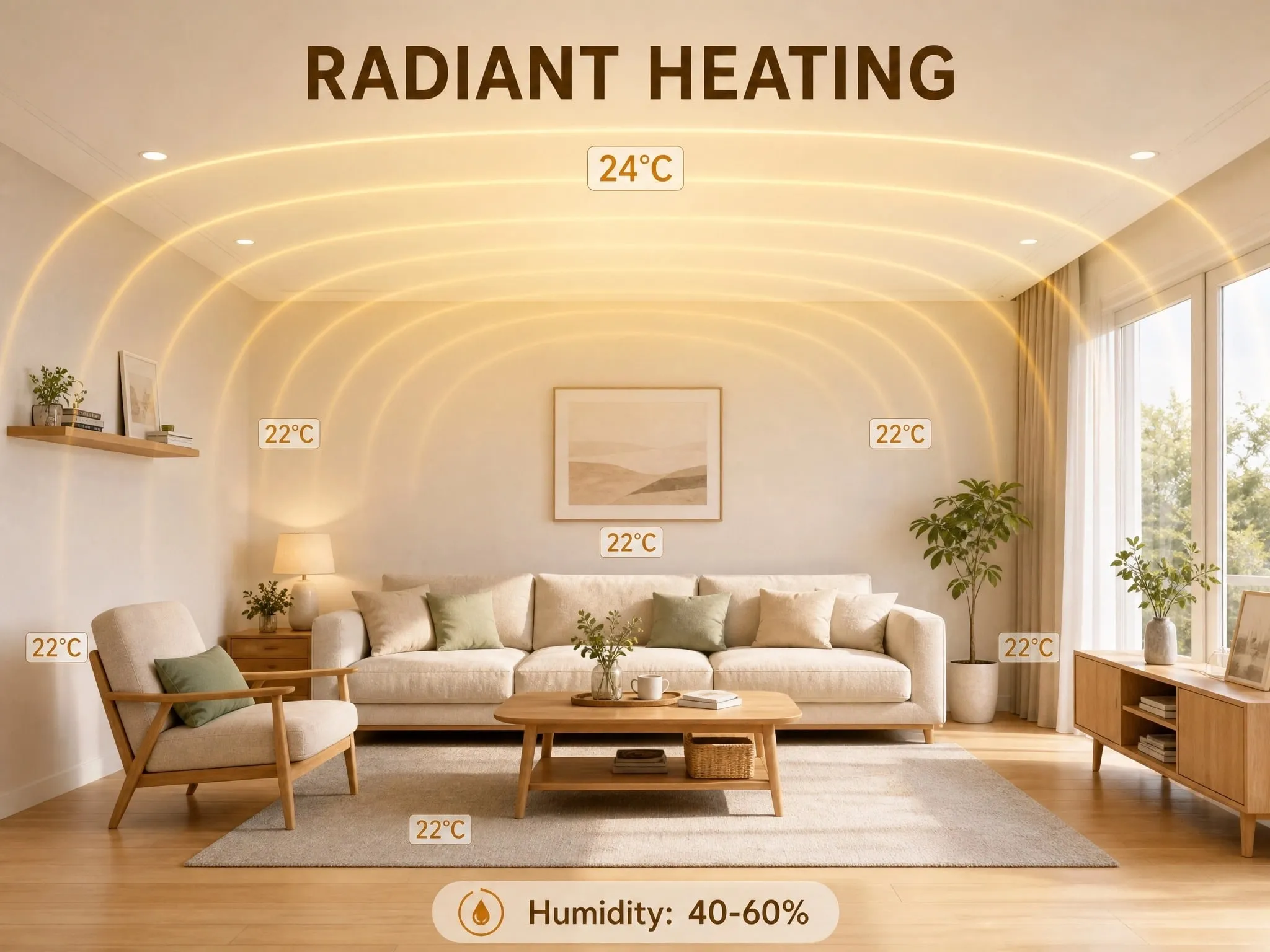
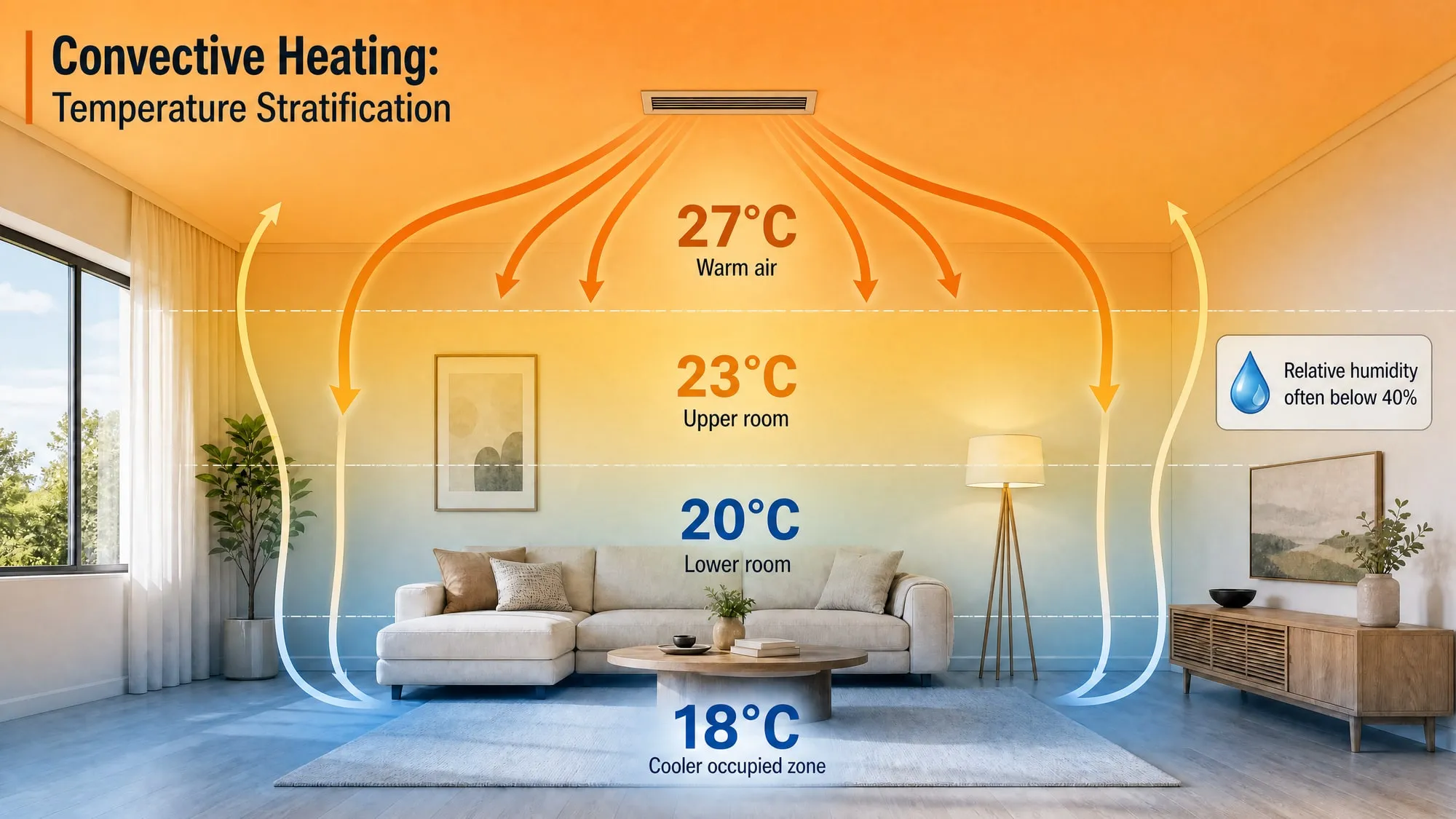
Radiant: the surfaces of the room are the heating
The whole floor, wall or ceiling emits far-infrared at a low surface temperature. Energy is absorbed by you and by the room's surfaces directly, so comfort holds when a door opens and the air is never heated hard enough to dry it out. Nothing is ducted or vented, and floor, wall and PowerBoard 250 systems are invisible once finished.
- Air movement and dust
- None
- Loss when a door opens
- Surfaces stay warm
- Equipment in the room
- None, except surface-mounted panels
- Annual maintenance
- None
The wavelength
We emit where your body already listens: six to fifteen micrometres.
Every warm object radiates in the infrared, and the wavelength it radiates at is set by its temperature. Skin at 37 °C emits long-wave infrared peaking at 9.4 µm. A Lamina Heat surface, at plaster or floor temperature, emits across 6 to 15 µm: the same band, centred on the same peak. That is not a coincidence we engineered. It is what a large surface at a moderate temperature does, and it is why the heat feels like warmth rather than radiation.
Short-wave heaters, the quartz and halogen bars that glow red, work at 1 to 3 µm. That band passes into the skin, lights the room, and feels harsh close up and useless a few metres away. Long-wave at 6 to 15 µm is absorbed in the outermost fraction of a millimetre, cannot be seen, and warms every surface it lands on as readily as it warms you.
Comfort at a lower air temperature
Because the body absorbs this band directly, occupants report comfort with the air 2–3 °C cooler than a convective system needs. That difference is most of the running-cost saving.
Nothing to see, nothing to glare
Emission at 6–15 µm is entirely outside the visible spectrum. No red glow, no hot spot, no light on the ceiling. The heating is invisible in every sense.
Surfaces warm, not just people
Walls, floors and furniture absorb the band and re-radiate it. The room's surfaces hold above dew point, humidity stays in the 40–60% band, and the warmth does not leave when a door opens.
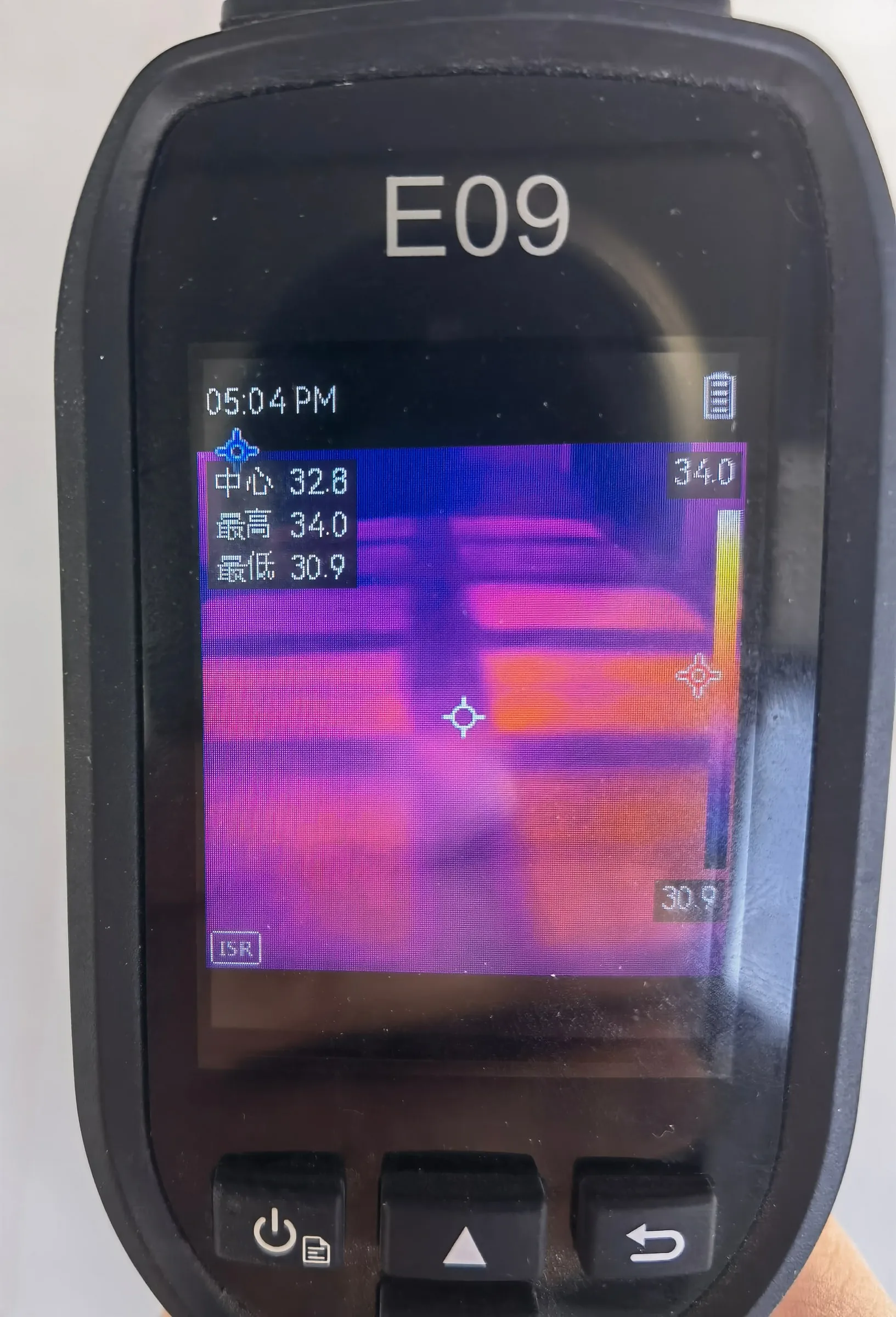
Seen through a thermal camera
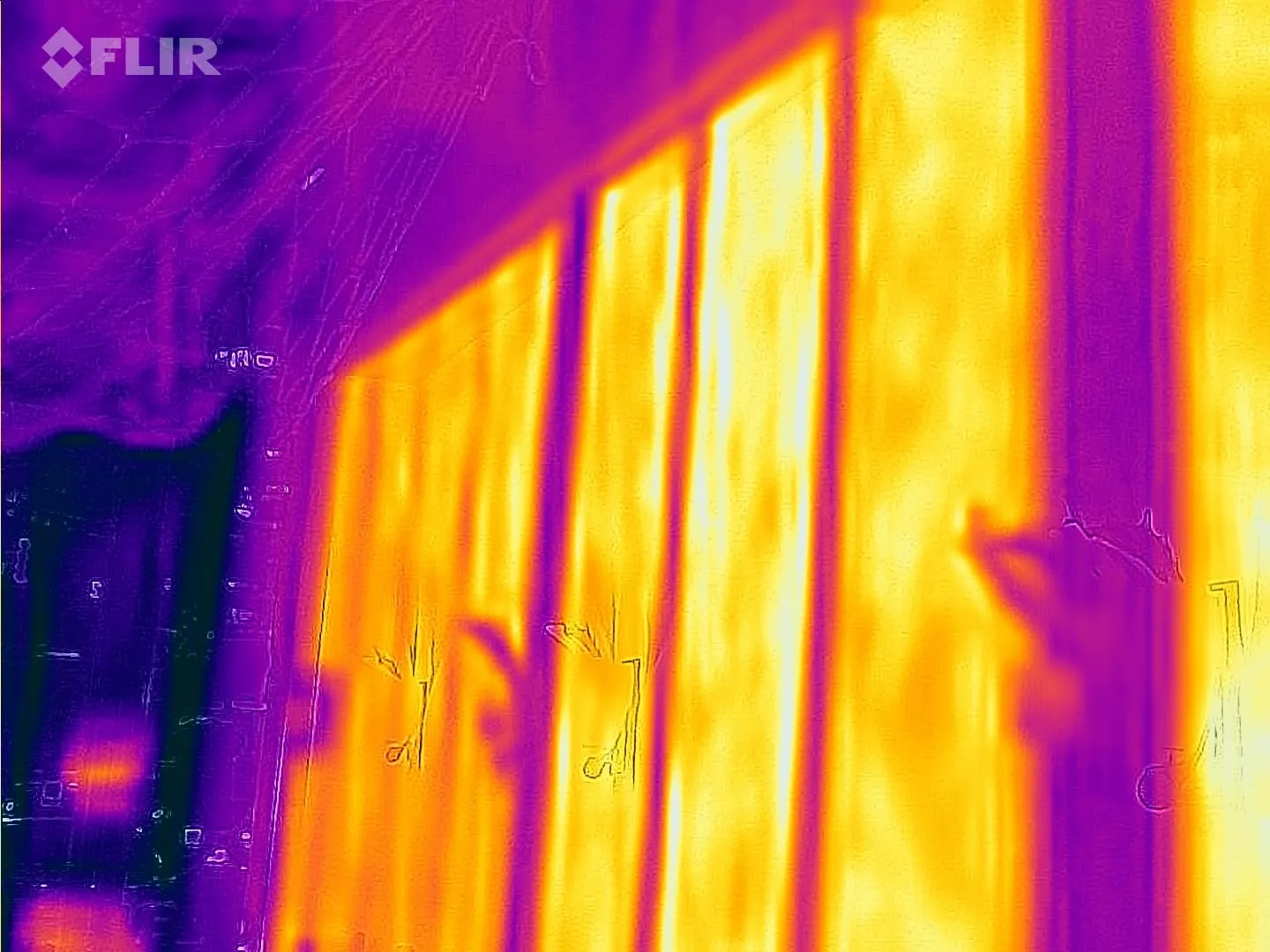
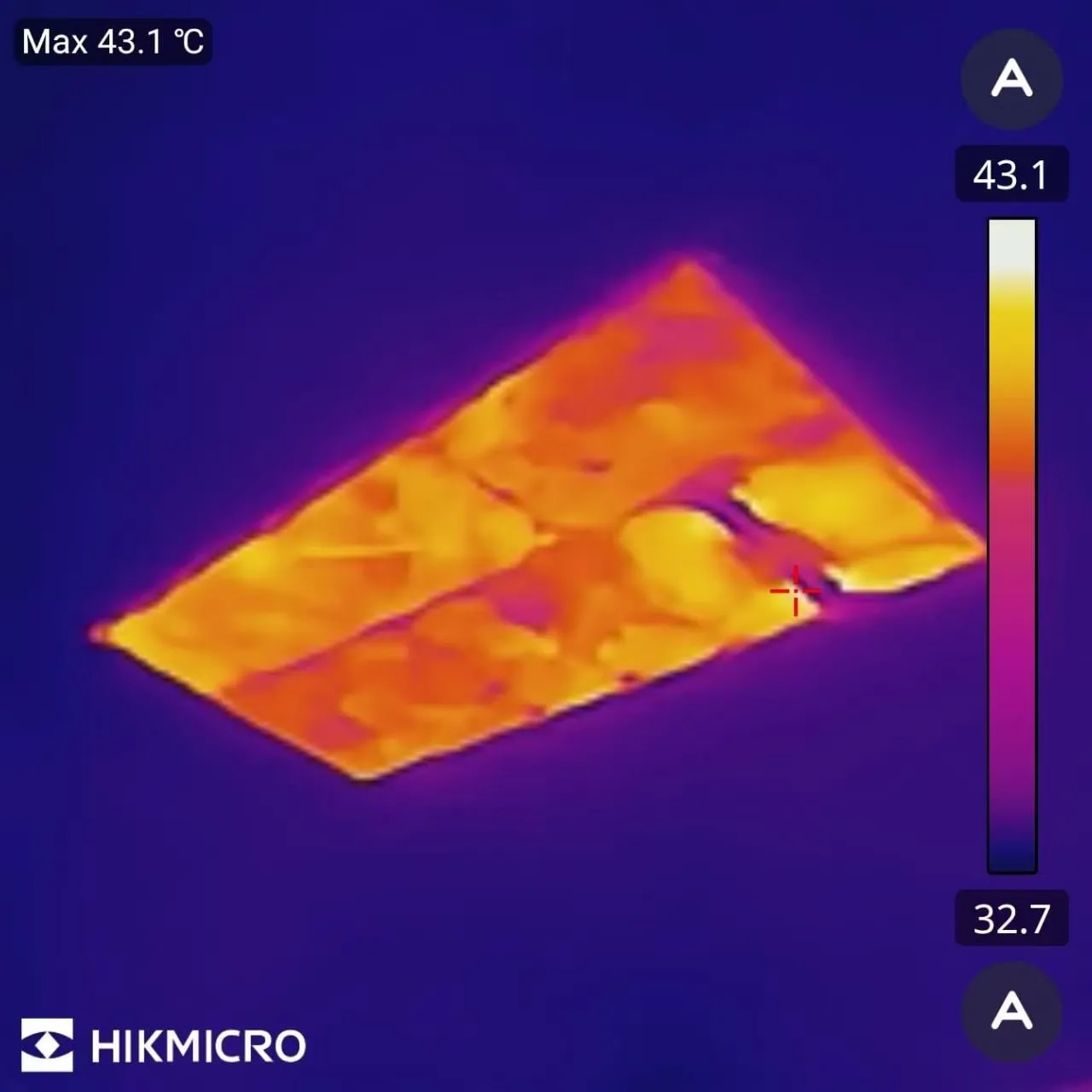
The whole surface emits. Not a wire on a spacing.
Every installation is checked with a thermal camera before handover. What it shows is the argument for full-surface heating in one picture: the entire element at one even temperature, and nothing else in the room warm at all.

Radiant explained, as data
The same room, two ways of heating it.
At 6–15 µm the radiation is the same band your own body emits: it is absorbed at the surface of the skin rather than penetrating it, and it does not heat the air it passes through. Occupants report comfort at an air temperature 2–3 °C lower than a convective system needs, and on the figure European energy agencies use — about 6% of heating energy for every 1 °C — that alone is roughly 12 to 18% less energy for the same felt warmth.
| Behaviour | Convective | Radiant surface |
|---|---|---|
| What is heated first | Air | Surfaces and people |
| Vertical gradient | 4–8 °C ankle to head | Under 2 °C |
| Relative humidity | Often dried below 40% | Held at 40–60% |
| Loss on air change | Heat leaves with the air | Surfaces stay warm |
| Distance, source to room | Plant room to emitter | 2–3 mm |
| Condensation risk on walls | Unchanged | Surfaces held above dew point |
| Maintenance | Annual service | None |
The biology
You lose most of your heat by radiation. So that is the loss worth stopping.
A resting body in an ordinary room sheds heat four ways: it radiates to the surfaces around it, it warms the air touching it, it conducts into whatever it is sitting on, and it evaporates moisture. Radiation is the largest of the four, roughly half of everything you give off.
You feel comfortable at thermal neutrality: the point where the heat you lose matches the heat your body makes. Get there and you stop noticing the room. That is why a cold window or an uninsulated wall makes you feel chilly at 21 °C. Those cold surfaces are pulling radiant heat out of you faster than your body replaces it, and no amount of warm air fixes it.
Comfort standards say the same thing in numbers. What you feel is closer to the operative temperature, roughly the average of the air temperature and the mean radiant temperature of the surfaces around you. Warm the surfaces and the mean radiant temperature rises, so you reach neutrality with cooler air. That is the whole mechanism, and it is why the air can sit 2 to 3 °C lower without anyone noticing anything except that the room is comfortable.
- Radiation, to the surfaces around you
- The largest single route, about half of resting heat loss
- Convection, to the air on your skin
- The route a radiator has to work through
- Evaporation, from skin and breath
- Rises sharply once air is heated hard and dried out
- Conduction, into what you touch
- Small, unless you are sitting on a cold floor
- What you actually feel
- Operative temperature: air and mean radiant temperature together
Proportions vary with clothing, activity and room conditions; the figures above describe a clothed adult at rest in a normally heated room.
Certified and tested
- IEC 60335-1 BEAB approved
- UL E526594 UL listed
- ISO 9001 Quality management
- CE EU conformity
- UKCA UK conformity assessed
- TÜV Type tested
Ready to feel the difference?Send us your building and we will plan it, free.
Project data, drawings or CAD files in. A room-by-room heat loss, element layout and priced proposal out. No obligation.