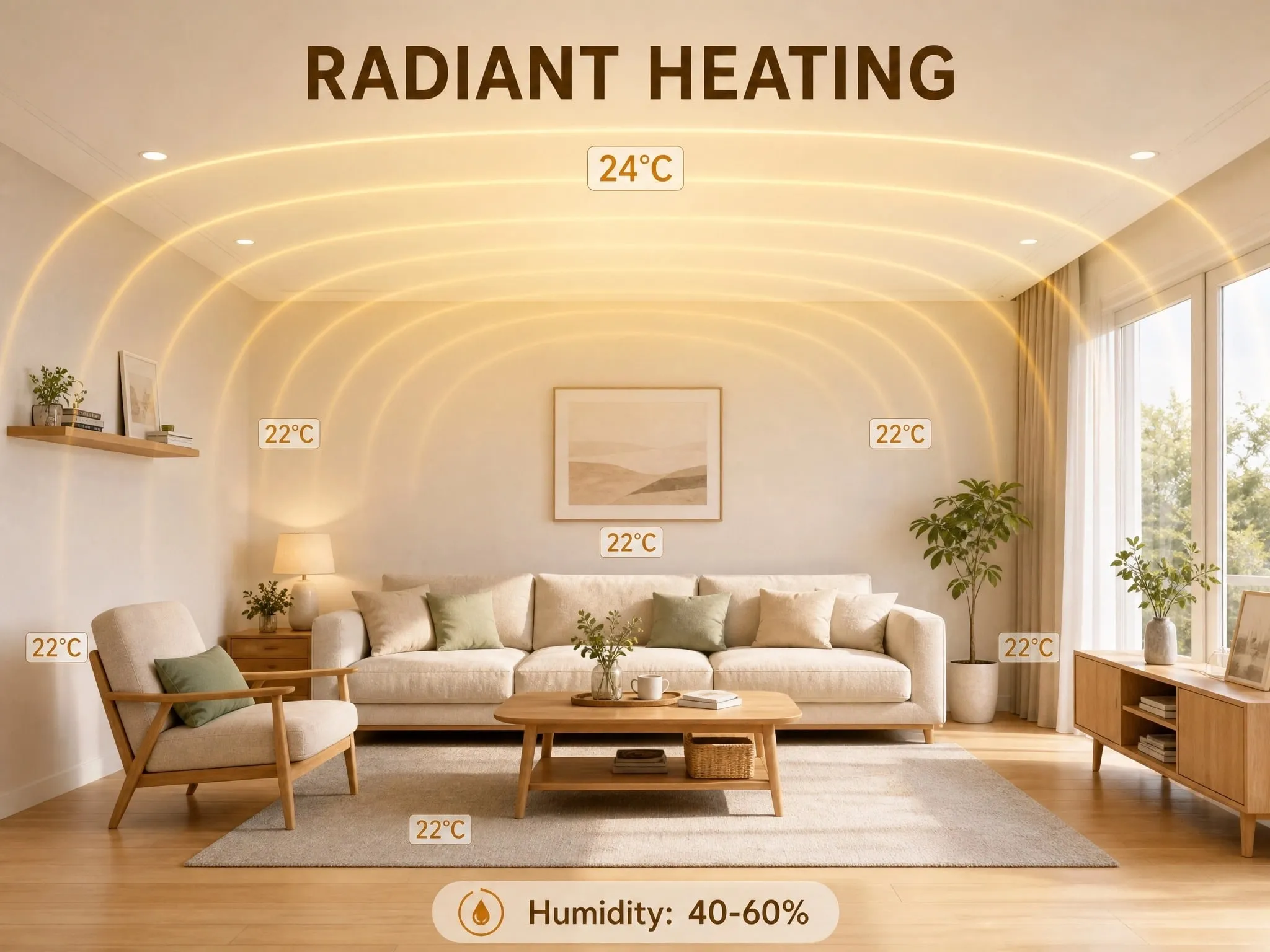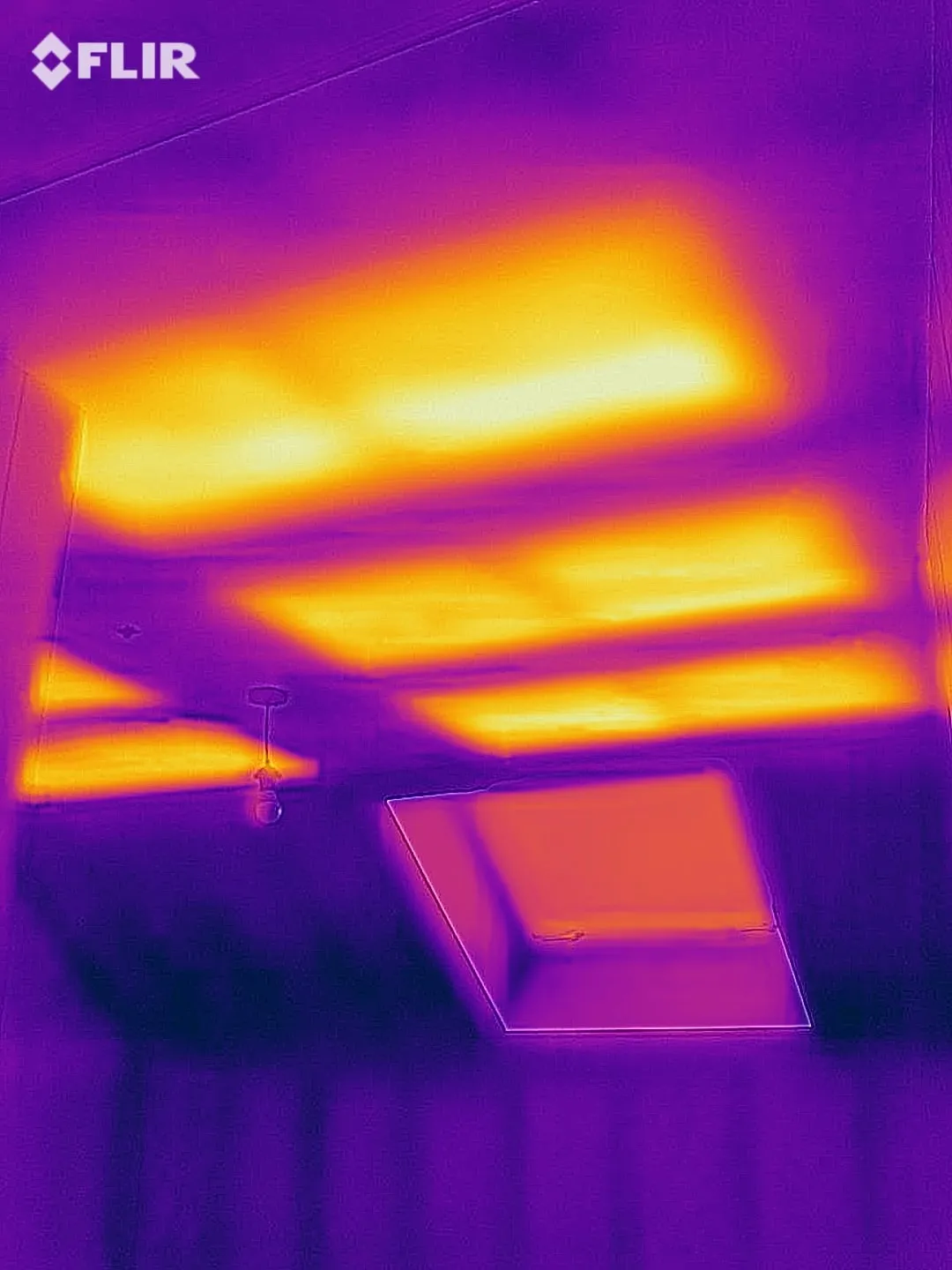
Why use carbon fibre to heat buildings?
Carbon fibre lets a heating element be a fraction of a millimetre thick, full-surface, perforable, non-combustible and unaffected by twenty years of heating cycles. Why the material decides the product.
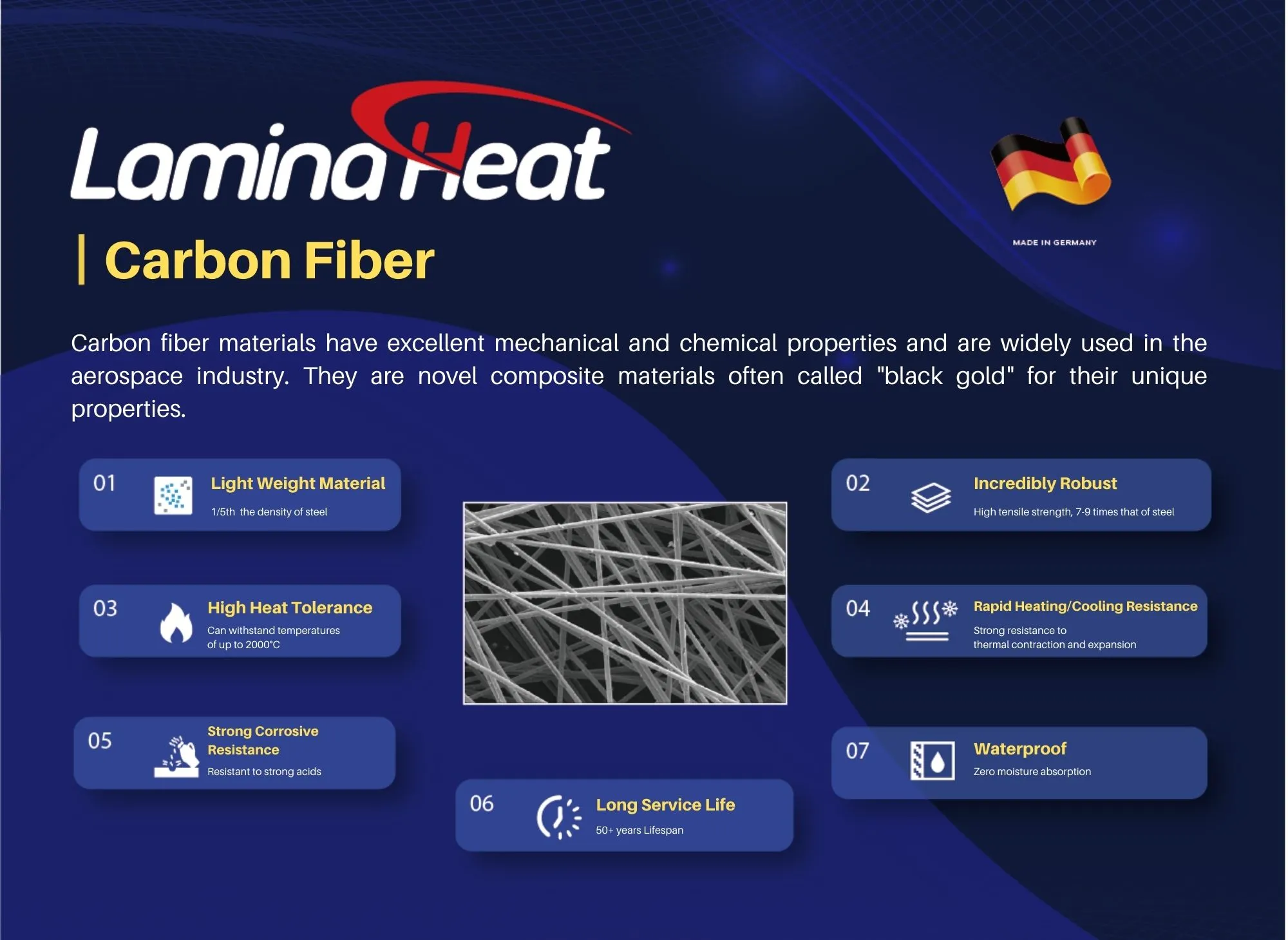
Everything distinctive about our heating systems — the thickness, the full-surface heat, the fact that you can drill through one and it carries on working — comes from the choice of material. So it is worth explaining what carbon fibre is and why it turned out to be the right thing to heat a building with.
What carbon fibre is
Carbon fibre starts as PAN — polyacrylonitrile — an acrylic-based polymer extruded into a white precursor fibre. That fibre then passes through a sequence of heat treatments: oxidation at 200 to 300 °C, carbonisation at 1,000 to 2,000 °C, and graphitisation at 2,000 to 3,000 °C, followed by surface treatment.
What emerges can be processed into woven fabrics, veils, unidirectional tapes, chopped fibres and prepregs, and it turns up in aerospace, automotive, sporting goods, wearables — and in the heating of buildings.
The reason it spans that range is its physical and chemical behaviour.
It is strong and very light
Carbon fibre has exceptional specific stiffness and strength: high-strength grades reach 4 to 5 GPa in tensile strength and 250 to 300 GPa in tensile modulus, at roughly a quarter of the density of steel.
For a heating element that has two consequences.
First, it can be thin. Our films are a fraction of a millimetre thick and still structurally sound, which is what allows the element to be integrated into a build-up without adding anything anyone would notice.
Second, it has very little mass. Low mass means very little thermal inertia, which means the element reaches working temperature in minutes and cools just as quickly. That responsiveness is what makes scheduling and zoning worth doing, and it is the opposite of a screed.
Its electrical behaviour is what makes it a heater
Carbon fibre is a semiconductor relative to metals, with electrical resistivity typically in the range of 15 to 17 µΩ·m.
That resistance is the point. Pass a current through it and it dissipates energy as heat — a resistive heater, but one distributed across an entire surface rather than concentrated in a wire.
Edison worked out the principle in 1880, when the filament in his lamp was carbonised cotton. Same physics, rather different application.
It hardly ages
This is the property that matters most for something you intend to bury in a building.
Repeated expansion and contraction is what eventually destroys most heating elements. Carbon fibre largely shrugs it off: its high tensile and compressive strength let it absorb the thermal stresses of cycling, and its coefficient of thermal expansion is low along the fibre. In a randomly oriented construction like ours, the effective CTE can be tailored to match the material the element is bonded into — so the element and the plaster around it move together instead of working against each other.
It is also remarkably resistant to fatigue, surviving millions of cycles. Carbon-fibre composites hold a fatigue strength around 80% of their static tensile strength; steel is typically below 50%.
The practical translation: an element installed today should be producing the same heat in twenty years. We had that tested independently, simulating twenty years of service — and the film’s tensile strength had actually increased over the test. We are happy to send the report.
It survives being built into things
Building materials get drilled, screwed into, bonded and covered. An element that cannot tolerate that is not a building product.
The random fibre structure means the film is insensitive to local damage: perforate it and it keeps working, because the current simply routes around the hole through the surrounding fibres. There is no single conductor to sever. It is also chemically inert, and unaffected by the great majority of reagents it will meet.
Together, those two properties are what let the film be laminated or embedded into plaster, adhesives, levelling compounds, plastics and polymeric coatings without the host material slowly destroying it. It is also why drilling into a heated wall later is not the disaster people assume.
Fire and water
Carbon fibre is classified as non-combustible and has no flash point. Held in a flame with fuel present it will eventually oxidise, but remove the flame and nothing continues to burn. There is no self-sustaining combustion.
It is also not hygroscopic and does not corrode, so it neither absorbs water nor rusts. That is what qualifies it for bathrooms, wet rooms and prolonged immersion — and it is the basis of the water-immersion testing behind our floor systems.
And it has a future
Carbon fibre is, at bottom, carbon. That opens up routes that metals do not have: precursors from organic and algal sources, and recycling processes driven by renewable energy.
For us the summary is simple. Carbon fibre is the reason the element can be 0.4 mm thick, full-surface, groundable across its entire area and safe to bury for the life of a building. No other material we have found does all of those at once.